

ISO 50001 has become the global benchmark for structured energy management systems in mining and industrial operations. For organisations seeking ISO 50001 compliance, the challenge is not understanding the Standard — it is operationalising it at scale.
In mining environments where diesel, electricity, and process energy represent high cost and carbon exposure, ISO 50001 requires more than documentation. It requires a robust, data-driven industrial Energy Management System (EnMS) capable of continuously monitoring performance, maintaining accurate baselines, and demonstrating measurable improvement.
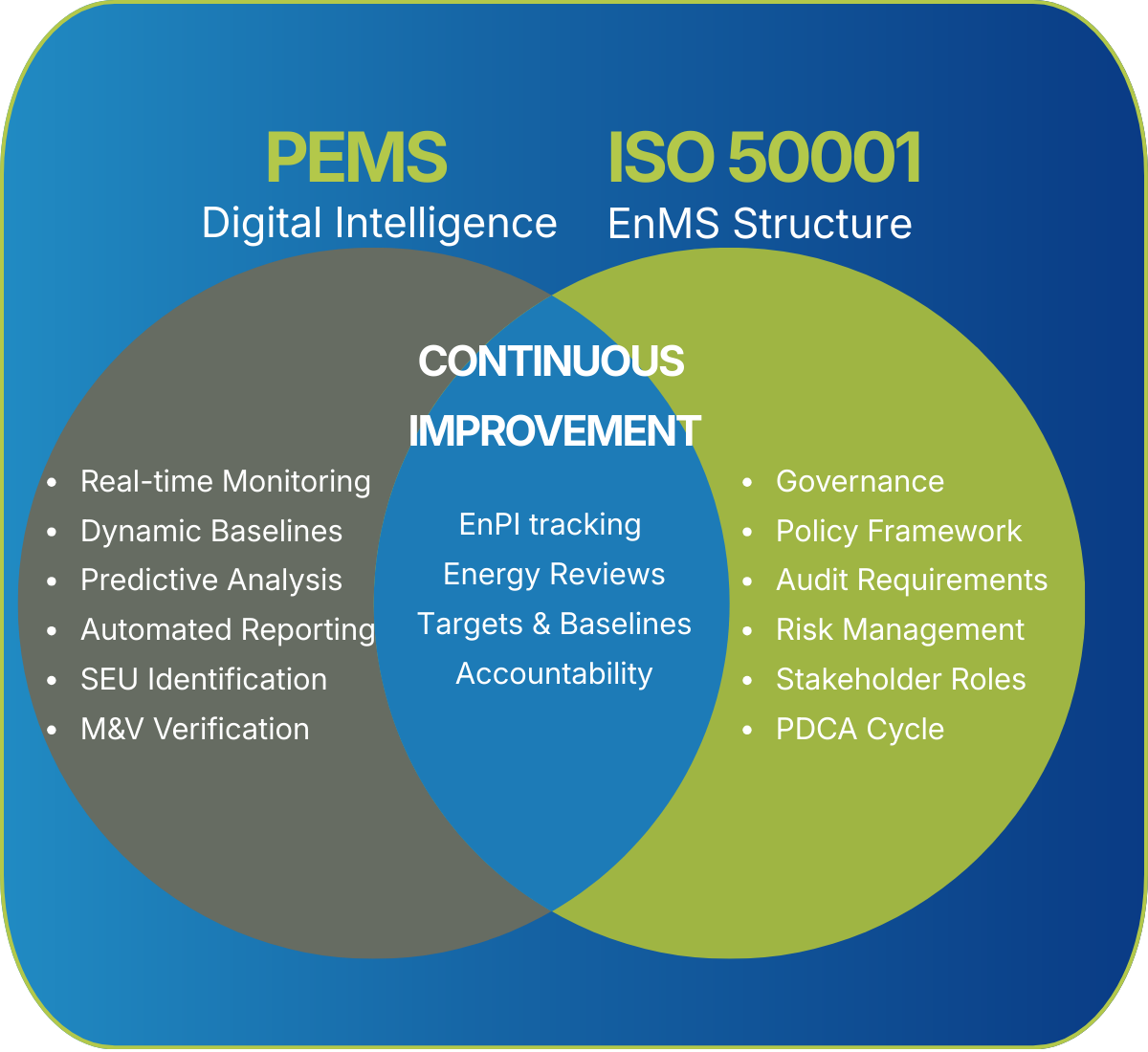
ECS’s PEMS™ (Productivity & Energy Management Services) provides that digital backbone — enabling mining and industrial operations to implement, sustain, and audit ISO 50001-aligned energy management systems with confidence.
What is ISO 50001 and why does it matter for mining operations?
ISO 50001 is a globally recognised management system standard designed to help organisations establish policies, objectives, and processes that improve energy performance.
Adopted in over 170 countries, it follows the familiar Plan-Do-Check-Act (PDCA) cycle and encompasses everything from leadership commitment and stakeholder engagement to operational control, measurement, and continual improvement.
But ISO 50001 is often misunderstood. It is not a prescriptive technical specification — it doesn’t tell you which equipment to buy or which processes to optimise. Instead, it defines what a good Energy Management System looks like: structured, evidence-based, accountable, and continuously improving.
This is precisely where many organisations struggle. The Standard’s requirements — energy reviews, baseline establishment, Energy Performance Indicators (EnPIs) tracking, and risk management — are demanding. Without the right tools, they become administrative burdens rather than operational advantages.
PEMS™: The Intelligence Behind ISO 50001 Compliance
PEMS™ is ECS’s integrated digital and analytical solution for mining and industrial operations. It combines site data, engineering expertise, and advanced analytics to deliver transparent visibility of performance against adjusted baselines — helping organisations identify inefficiencies, quantify energy and cost-saving opportunities, and track improvement initiatives through structured reporting and stakeholder engagement.
At its core, PEMS™ operates across a structured performance management lifecycle:
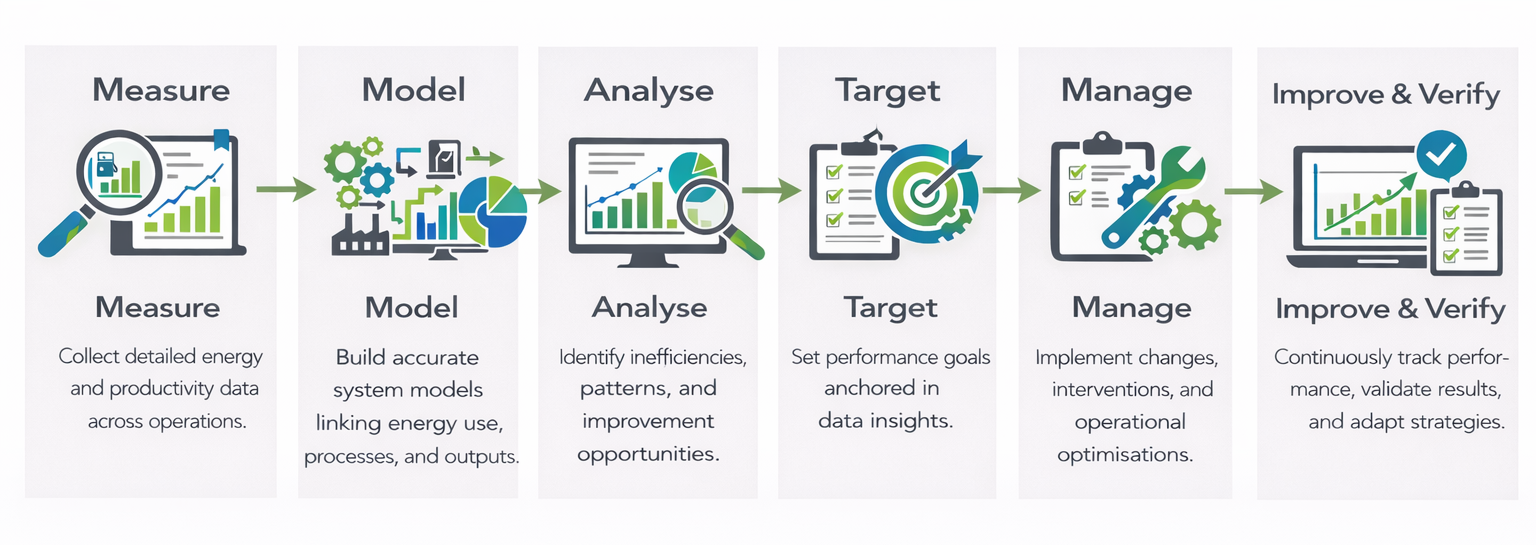
This isn’t a one-off improvement project — it’s a continuous improvement engine, and critically, one that maps precisely onto the (PDCA) philosophy of ISO 50001.
Clause-by-Clause Alignment: ISO 50001 Requirements in Practice
The following sections walk through the key clauses of ISO 50001 and explain — in practical terms — how PEMS™ fulfils, sustains, and operationalises each requirement. This is not theoretical alignment; it reflects the day-to-day operational reality of PEMS™ deployments across mining and industrial sites.
Section 4: Context — Knowing Where You Stand
ISO 50001 begins with context. Before an organisation can manage its energy, it must understand its operational environment: the internal and external factors that influence energy performance, the stakeholders whose expectations must be met, and the boundaries within which the Energy Management System operates.
PEMS™ addresses this foundational requirement by consolidating operational, production, energy, and cost data into a single, continuously updated view. Rather than periodic context reviews — which quickly become outdated — PEMS™ provides a living, data-backed understanding of the operational landscape. As production profiles shift, equipment changes, or external pressures evolve, PEMS™ reflects these realities in near real-time.
Importantly, PEMS™ enforces defined EnMS boundaries through structured asset hierarchies and system tagging. Scope is not a document — it’s a configuration. This prevents the ‘scope drift’ that frequently undermines EnMS integrity, ensuring that what is measured and reported today remains consistent with what was defined at the outset.

Section 5: Leadership — Turning Commitment into Evidence
ISO 50001 places significant emphasis on top management. Leadership must demonstrate genuine commitment — not just through policy statements, but through active involvement in energy performance reviews and decision-making. Energy policy must be aligned with continuous performance improvement, and roles, responsibilities, and authorities must be clearly defined and enforced.
This is where many EnMS implementations falter. Leadership engagement often degrades into compliance theatre: signed policies, attended reviews, but limited genuine insight into energy performance.
PEMS™ changes this dynamic fundamentally. By linking energy performance directly to cost, risk, and operational outcomes through transparent, decision-ready reporting, PEMS™ equips leaders with the insight to act — not just review. Regular executive dashboards and structured performance reports ensure that management reviews are grounded in evidence, and that the energy policy translates into measurable indicators that guide action throughout the year.
Role-based access and responsibility tracking within PEMS™ further ensures that accountability is auditable — not just assigned — creating a clear chain of evidence from policy commitment to operational outcomes.
Section 6: Planning — The Analytical Heart of ISO 50001
Planning is the most analytically demanding section of ISO 50001. It requires organisations to conduct thorough energy reviews, identify and prioritise Significant Energy Uses (SEUs), establish Energy Performance Indicators (EnPIs), develop statistically robust energy baselines, set objectives and targets, and proactively address energy-related risks and opportunities.
This is PEMS™’s natural habitat.
Energy Review & SEU Identification
PEMS™ automates and maintains the energy review via continuous analysis of energy use across assets, processes, and activities. SEUs are identified and prioritised through quantitative contribution, variability, and intensity analysis — and SEU rankings are automatically updated as operational conditions change. This ensures that energy risk management reflects operational reality, not last year’s snapshot.
EnPIs and Baselines
PEMS™ establishes, calculates, and maintains EnPIs using consistent, statistically sound methodologies — including activity-normalised and efficiency-based indicators. Baselines are developed as living references, not fixed historical averages, reflecting normal operating conditions and relevant variables through dynamic modelling.
Critically, when significant operational or structural changes occur, PEMS™ supports baseline adjustments through documented change logic with full audit traceability — satisfying both the analytical and governance requirements of ISO 50001.
Risks, Opportunities, and Targets
Rather than relying on periodic risk reviews, PEMS™ continuously evaluates deviations from expected energy performance, flagging abnormal trends and emerging risks in real time. Objectives and targets are linked directly to monitored indicators and action plans, with progress tracked dynamically — ensuring that planning remains responsive to operational realities, not just compliance calendars.

Section 7: Support — Building Capability at Scale
ISO 50001 recognises that an EnMS is only as strong as the people, processes, and information systems that support it. Section 7 addresses competence, awareness, communication, and documented information — the organisational infrastructure that makes the EnMS work.
PEMS™ reduces dependence on individual expertise by embedding standardised analytical logic and methodologies into the platform itself. This democratises competence: the quality of energy performance evaluation doesn’t fluctuate with staff turnover or individual skill variation.
Energy performance is made visible at both operational and management levels — reinforcing energy conscious behaviour through transparency and enabling structured, consistent internal communication. Automated reporting ensures that communication occurs as planned and at defined frequencies, rather than depending on manual effort.
PEMS™ also acts as a controlled repository for energy performance data, reports, and records — maintaining version control, accessibility, and retention in accordance with EnMS documentation requirements.
Section 8: Operation — Control, Design & Procurement
Operational control under ISO 50001 requires organisations to manage their Significant Energy Uses to defined performance thresholds and to integrate energy performance criteria into design and procurement decisions.
PEMS™ monitors performance against defined thresholds and identifies deviations in SEUs — enabling timely corrective actions that maintain operational control. For design and procurement, PEMS™ supports energy-conscious decision-making through performance scenario modelling and lifecycle energy performance assessments — ensuring that new assets and services are evaluated for their energy impact before commitment.
Section 9 & 10: Evaluation, Audit & Continual Improvement
The final sections of ISO 50001 close the PDCA loop — requiring systematic monitoring and measurement, internal audits, management reviews, and a structured approach to nonconformity and corrective action. Above all, they demand continual improvement: not just one-off gains, but sustained performance over time.
PEMS™ provides continuous, systematic monitoring and analysis of energy performance and EnMS effectiveness — ensuring that evaluation is objective, consistent, and data-driven. Internal audits are facilitated by readily accessible, structured evidence covering performance monitoring, analysis, and review activities.
The table below provides a consolidated view of how PEMS™ addresses each clause of ISO 50001, from organisational context through to continual improvement.

Measurement and Verification (M&V) for Sustained Energy Performance
Nonconformities are identified through performance deviation analysis and root-cause investigation — not just discovered during audits. And continual improvement is sustained through measurement and verification aligned with MnV Protocols, ensuring that energy performance improvements are maintained over time and that regression after interventions is detected and addressed.

ISO 50001 Certification and Continuous Improvement
ISO 50001 certification is increasingly becoming a commercial expectation — required by major customers, demanded by regulators, and expected by investors applying ESG criteria. But the real value of the Standard lies not in the certificate, but in the management system it creates.
PEMS™ amplifies this value proposition across four dimensions:
- Financial Confidence: Every energy performance improvement is quantified, tracked, and verified against statistically robust baselines — making savings real, defensible, and reportable.
- Operational Efficiency: By automating the analytical and reporting infrastructure of ISO 50001, PEMS™ dramatically reduces the manual burden of EnMS compliance, freeing engineering and management resources for improvement, not administration.
- Sustainability Credibility: PEMS™ provides the Measurement and Verification backbone needed to substantiate GHG reduction claims — supporting both regulatory compliance and voluntary sustainability commitments.
- Scalable Intelligence: As operations scale, expand, or evolve, PEMS™ adapts — maintaining EnMS integrity without requiring disproportionate increases in analytical resources.
ISO 50001 provides the framework. PEMS™ provides the intelligence. Together, they create an Energy Management System that is not just compliant — but genuinely effective.
For mining and industrial organisations operating in environments where energy costs are significant, sustainability expectations are rising, and operational complexity is increasing, the combination of ISO 50001’s structured governance and PEMS™’s analytical depth represents a powerful strategic advantage.
PEMS™ doesn’t help organisations meet ISO 50001 requirements on paper. It helps them live those requirements every day — in every report, every review, every decision, and every improvement verified.
How PEMS™ addresses each clause of ISO 500001
| Clause | Area of Focus | How PEMS™ Enables Compliance | Cadence |
|---|---|---|---|
| 4.1 | Organisational Context | Consolidates operational, production, energy, and cost data into a single living view; continuously adapts to internal and external changes in near real-time. | Weekly–Annually |
| 4.2 | Stakeholder Expectations | Delivers tailored dashboards and reports for management, finance, sustainability, operations, and production teams. | Monthly–Annually |
| 4.3 | EnMS Scope | Enforces defined EnMS boundaries using structured asset hierarchies and system tagging; prevents scope drift. | Quarterly–Annually |
| 4.4 | EnMS Establishment | Acts as the digital execution layer of the EnMS — embedding monitoring, analysis, reporting, and review into routine operations. | Weekly–Annually |
| 5.1 | Leadership & Commitment | Provides executive-level reporting linking energy performance to cost, risk, and operational outcomes for informed leadership decisions. | Weekly–Annually |
| 5.2 | Energy Policy | Operationalises the energy policy by converting commitments into measurable, trackable KPIs and trends. | Weekly–Annually |
| 5.3 | Roles & Accountability | Assigns ownership of EnPIs, reports, and action plans; makes accountability auditable over time. | Weekly–Annually |
| 6.1 | Risks & Opportunities | Continuously evaluates deviations from expected energy performance; identifies abnormal trends and emerging risks proactively. | Weekly–Annually |
| 6.2 | Objectives & Targets | Links objectives directly to monitored indicators and action plans; dynamically tracks progress against targets. | Weekly–Annually |
| 6.3 | Energy Review & SEUs | Automates and maintains the energy review via continuous analysis; identifies and prioritises Significant Energy Uses (SEUs). | Weekly–Annually |
| 6.4–6.6 | EnPIs & Baselines | Establishes statistically robust baselines and EnPIs using consistent methodologies; supports baseline adjustments with full audit traceability. | Monthly–Annually |
| 7.1–7.5 | Resources, Awareness & Communication | Automates structured reporting; embeds standardised logic to reduce manual effort; acts as a controlled repository for all EnMS documentation. | Weekly–Annually |
| 8.1–8.3 | Operational Control & Procurement | Monitors performance against thresholds; supports energy-conscious design through scenario modelling; informs procurement decisions. | Monthly–Annually |
| 9.1–9.3 | Monitoring, Audit & Review | Provides readily accessible audit evidence; consolidates management review inputs; tracks nonconformities and root-cause investigations. | Monthly–Annually |
| 10.1–10.2 | Nonconformity & Continual Improvement | Sustains continual improvement by measuring and verifying energy performance improvements aligned with MnV Protocols. | Monthly–Annually |
Partner with ECS for ISO 50001 Compliance and Energy Management Excellence
ECS’s PEMS™ team works with mining and industrial organisations to design, implement, and sustain ISO 50001-aligned Energy Management Systems backed by advanced analytics and performance verification.
Whether you are pursuing ISO 50001 certification or strengthening your existing EnMS framework, we provide the structured monitoring, reporting, and verification required for audit readiness and continual improvement.
- Email Peter Meyer [ECS Marketing and Sales Director] or contact us via our contact page to discuss your ISO 50001 implementation strategy.