

Mining operations that still rely on manual inspection methods are leaving significant savings — and safety — on the table. The evidence is accumulating: poor mine haul road conditions drive up fuel and tyre costs, slow production, and compromise the safety of every person on the road. ECS’s SmartRoad™ solution is proving that digital haul road management delivers measurable results where it matters most.
Haul roads are the arteries of a mine. Every tonne of ore moved, every litre of fuel consumed, every tyre worn — all of it passes over these roads. Yet for many operations, the management of this critical infrastructure remains rooted in methods that have changed little in decades. The consequences are significant and measurable.
Poor mine road conditions impede the efficient movement of product, drive up fuel consumption, accelerate tyre wear, increase vehicle maintenance costs, and — critically — compromise the safety of everyone on the network.
According to Dr Mark Rawlins Pr Eng, Executive Chairperson and Chief Engineer at Energy & Combustion Services (ECS), the gap between what traditional inspection methods deliver and what mines actually need is widening.
“Road conditions can change rapidly due to weather — resulting in rain-damaged, slippery, or dusty conditions,” says Rawlins. “Being able to readily assess road conditions before resuming production is critical. And having a historical record of compliance is essential.”

The Limits of Traditional Mine Road Inspection
Traditional haul road inspection — a competent person driving the network, making notes or taking photographs, then filing a report — presents three fundamental problems: frequency, completeness, and repeatability.
- How often can the same section of road be inspected?
- How much of the total network is covered in a given period?
- And how consistently does an inspector score the same defect from one period to the next?
For most operations, the honest answer to all three is: not well enough. Add to this the absence of any structured system for reporting defects, scheduling mine haul road maintenance, or tracking job close-out — and the result is a cycle of reactive, inefficient road management that drives cost rather than containing it.
A further compounding factor is the absence of geospatial context. Traditional methods cannot produce location-pinned defect records, heat maps of road condition, or a structured maintenance history.
Without this, trending road performance over time — or demonstrating compliance to regulators — becomes guesswork. Job cards are informal, follow-up is inconsistent, and corrective action is rarely tracked through to close-out.
“Roads are costly to build and maintain and are the principal means for moving material around the mine,” Rawlins notes. “Deterioration in road quality leads to additional energy costs and reduced productivity. The traditional approach does not meet the needs of road ownership.”
A Digital Platform Built for the Realities of Mining
SmartRoad™, developed by ECS, is a digital road performance management platform that addresses these challenges directly. At its core is the SmartRoad ARID™ device (Autonomous Road Inspection Device) — a ruggedised unit mounted to haul trucks or service vehicles that performs continuous, autonomous visual and dynamic haul road inspections as part of normal operations.
Powered by AI and Machine Learning algorithms, SmartRoad ARID™ assesses road defects and conditions with a level of consistency and coverage that manual methods cannot match. Inspections happen at the frequency the operation demands — not at the frequency a schedule allows.
The data captured feeds into a cloud-based platform accessible via any web browser. Road condition dashboards display heat maps, geospatially pinned defects, condition trends, and full inspection history. Mine haul road maintenance teams can identify problem areas at a glance, schedule and assign repairs, navigate to defect locations, and close out jobs — all within the same system.
Safety Built Into Every Inspection
SmartRoad ARID™ enhances safety across three dimensions that traditional inspection cannot match:
- Autonomous and rapid inspections eliminate the need to send personnel onto the active mine road network for routine assessments.
- Inspection units operate in low-light and night-time conditions, ensuring the road network is assessed across all production shifts.
- Units deployed on production trucks can monitor dust levels at load and dump areas in near real time, enabling supervisors to act before conditions become hazardous.
Short-interval alerts notify supervisors of conditions that pose immediate safety risks — excess dust, potholes, rutting, standing water, and large rocks on the road surface. These alerts are particularly valuable when ARID™ units are mounted on production trucks, where dust generated by other vehicles can be detected and reported within minutes.
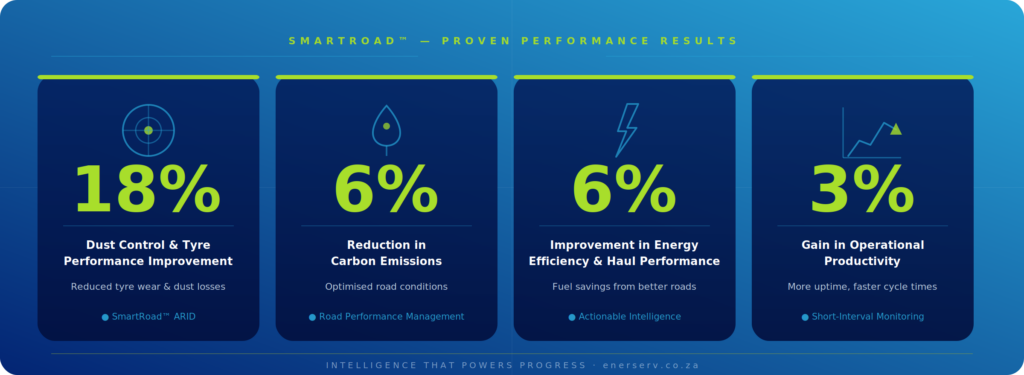
Mining Haul Road Efficiency: Intelligence That Drives Outcomes
Where SmartRoad™ distinguishes itself is in its emphasis on actionable intelligence and its direct impact on mining haul road efficiency. The platform is built to ensure the right information reaches the right person at the right time — linking road performance data directly to fuel consumption, tyre life, emissions, and cycle time.
SmartRoad™ integrates with ERP systems, Microsoft Excel, and Power BI, connecting road performance intelligence to broader operational reporting without friction. This means that the cost impact of mine road conditions — on energy, tyres, productivity, and carbon — becomes visible to the people responsible for managing it.
As Dr Rawlins explains: “Modernising road condition monitoring by exploiting advances in 4IR, IIoT, Machine Learning and AI enables significant savings in energy usage, carbon emissions, tyre consumption, and water usage.”

Mine Haul Road Maintenance Management: Compliance and History
The compliance dimension is increasingly significant. SmartRoad™ maintains a full inspection history — covering both compliant and non-compliant road states — enabling meaningful trending across periods, road life analysis, and the documented safety evidence that regulators and insurers require. This mine haul road maintenance record is continuously available, without placing additional burden on the operational team.
Road Performance Dashboards provide geospatially pinned information on maps of the entire mine road network, with powerful analytics spanning detailed defect records, heat maps of overall condition, and historical inspection reports with photographs. Corrective action workflows and escalations are managed digitally within the same platform.
Configured for Each Operation
SmartRoad™ is configured to accommodate the specifics of each mine haul road network, with bespoke road maps and operational zones established at implementation. Reporting is layered: high-level condition trends and compliance dashboards sit alongside granular defect records and maintenance histories.
Delivered as a monthly subscription encompassing autonomous road inspection hardware, cloud-based dashboards, digital road network setup, training, and a dedicated ECS support team, SmartRoad™ allows operational teams to focus on roads — while ECS manages the technology environment end to end.
“The emphasis of SmartRoad’s reporting is ensuring complete, actionable information reaches the right person at the right time. Ultimately, miners want safe and compliant roads with the least cost of ownership — and SmartRoad™ is a key enabler for this,” concludes Dr Rawlins.