
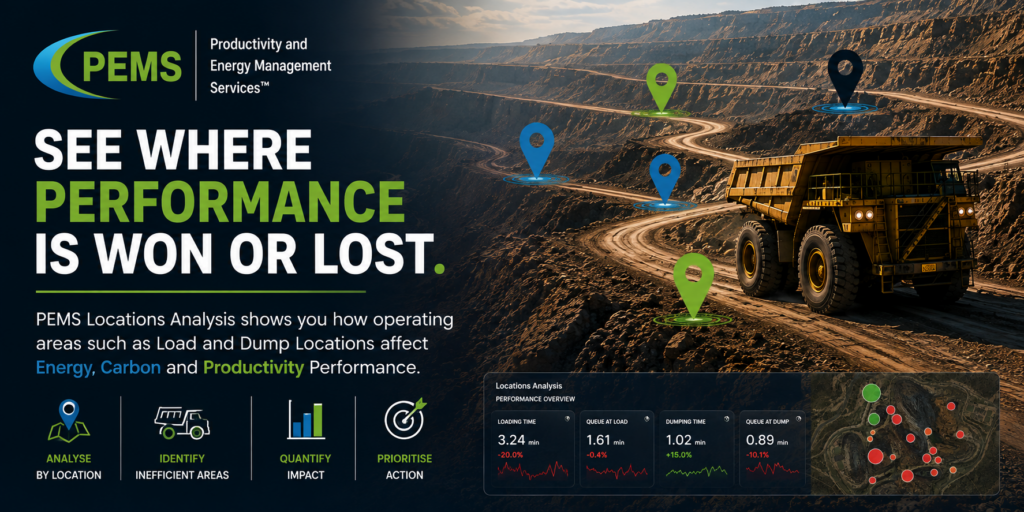
Mining performance is not only influenced by the equipment being operated. Where that equipment operates can have an equally significant impact on productivity.
Loading areas, dumping locations and other operating zones can introduce delays that are often difficult to identify when performance is assessed only at the fleet or equipment level.
PEMS Locations Analysis gives mining operations visibility into how performance changes across operating locations, helping teams identify where productivity is gained or lost.
Moving Beyond Equipment Analysis
Traditional fleet analysis typically focuses on the performance of individual trucks or equipment groups. While this remains important, it does not always explain why performance deteriorates.
A truck may show a longer cycle time, but the underlying issue may not be the truck itself. It could be linked to:
- Excessive loading time at a particular loading location
- Queuing at a high-traffic area
- Extended dumping time at a specific dump location
- Repeated operational delays associated with a particular area of the mine
PEMS Locations Analysis adds this important operating context.
By combining Production Data with location-based analysis, PEMS helps operations understand where these losses are occurring and which areas have the greatest impact on overall productivity.
Turning Production Data Into Location Intelligence
PEMS Locations Analysis evaluates production performance across Load and Dump Locations, allowing operational teams to compare the performance of different areas against defined targets.
This provides a structured way to move from simply identifying that performance has deteriorated to understanding where the deterioration is occurring. The analysis enables operations to:
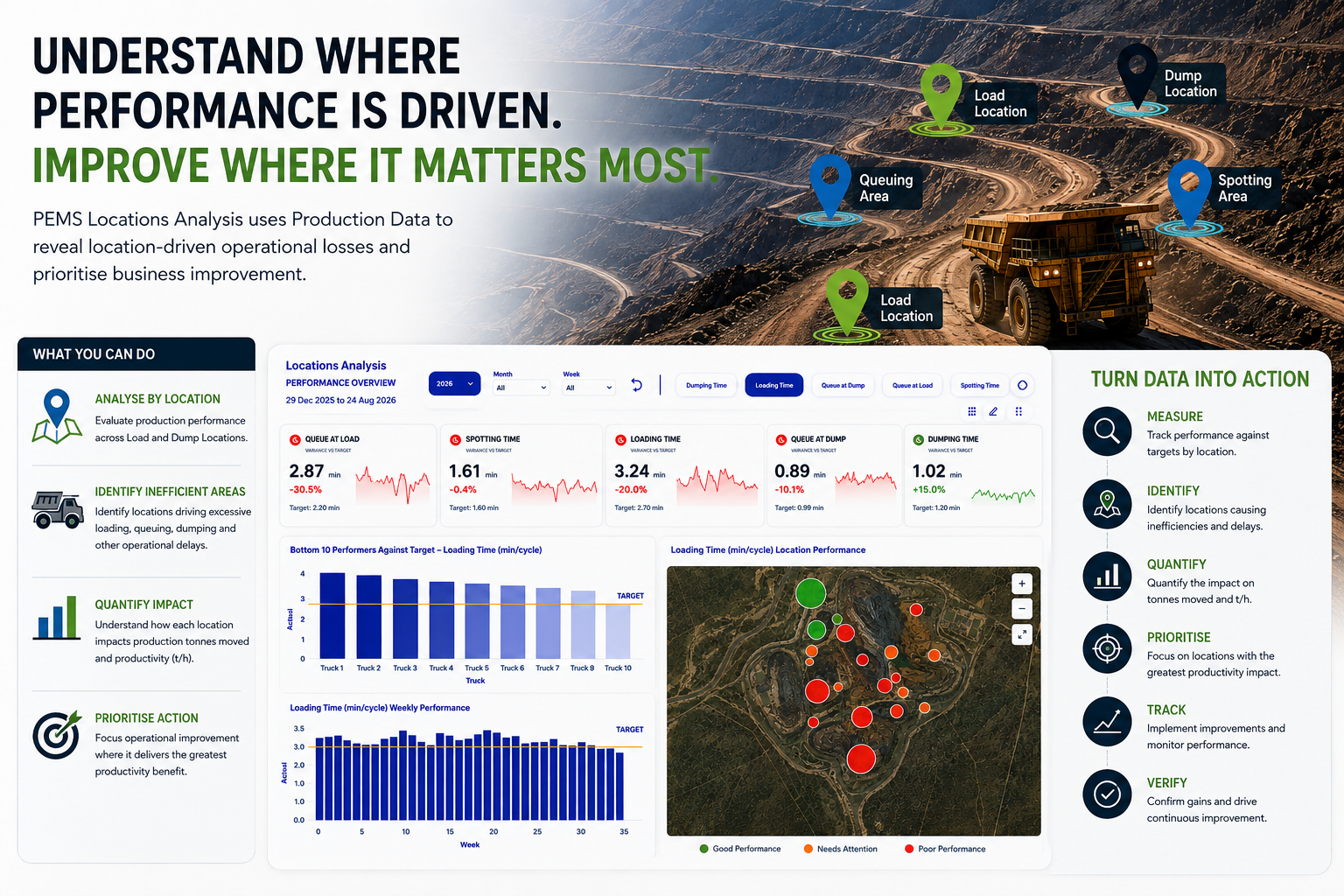
Analyse Performance by Location: Evaluate production performance across individual Load and Dump Locations and understand how performance varies across the mining operation.
Identify Inefficient Areas: Identify locations driving excessive loading, queuing, dumping and other operational delays. Instead of treating these delays as fleet-wide issues, teams can isolate the specific locations contributing to poor performance.
Quantify the Impact: Understand how each location affects production tonnes moved and productivity (t/h). This allows operational teams to determine which locations have the greatest influence on site performance.
Prioritise Improvement: Not every operational issue has the same impact. Locations Analysis helps teams focus improvement activities where they can deliver the greatest productivity benefit, allowing resources and operational interventions to be directed toward the highest-value opportunities.
From Data to Actionable Insight
The objective of Locations Analysis is not simply to provide another dashboard. It is to help operational teams answer practical questions such as:
- Which locations are driving excessive cycle times?
- Where are loading, queuing or dumping delays occurring?
- Which locations have the greatest impact on productivity?
- Where should operational improvement efforts be prioritised?
Through visual location mapping, performance trends, equipment comparisons and target-based analysis, PEMS provides a clear view of where operational losses are concentrated.
This allows teams to move from a broad performance problem to a specific operational focus area.
Understanding Performance in Context
Consider a fleet where loading time is consistently above target. An equipment-level analysis may show which trucks are experiencing the longest loading times. Locations Analysis goes one step further.
It can identify that several of those trucks are repeatedly operating from the same loading location, highlighting that the underlying issue may be associated with the operating area rather than the equipment.
This distinction is critical. It allows teams to investigate the actual operational driver — whether related to loading practices, congestion, equipment interaction, operating conditions or another site-specific constraint.
A Clearer Path to Continuous Improvement
PEMS Locations Analysis supports a simple performance improvement cycle:
Measure → Identify → Quantify → Prioritise → Track → Verify
Performance is first measured against operational targets.
Inefficient locations are then identified and their impact quantified.
Improvement opportunities can subsequently be prioritised based on their potential business value, with performance tracked after implementation to determine whether the intervention delivered the intended result.
This creates a repeatable approach to operational improvement rather than relying on isolated investigations or assumptions.
See Where Performance Is Won or Lost
Every minute of additional loading time, unnecessary queuing or inefficient dumping contributes to lost productive capacity. The challenge is knowing where to focus.
PEMS Locations Analysis uses Production Data to reveal location-driven operational losses and prioritise business improvement.
By giving mining teams a clearer understanding of where performance is being gained or lost, PEMS enables more targeted interventions, stronger operational decisions and improved productivity across the mining value chain.
- Want to understand where productivity is being lost across your operation? Contact us to discover how PEMS Locations Analysis can turn your production data into actionable location-based insight.