
South Africa’s diesel refund scheme is going through its biggest change in more than two decades. SARS is moving the refund off the VAT return and onto a standalone system, primary producers can now claim on 100% of eligible diesel, and the new rules point firmly towards prescribed monthly logbooks and risk-based verification.
For operations that rely on the refund, the message is simple. The value of every eligible litre has gone up, and so has the standard of proof needed to claim it.
What Is Changing
- A standalone diesel refund system. Since 2001, the refund has been administered through the VAT return. SARS is decoupling it from VAT and moving it onto its own registration and claims process on eFiling. The new Diesel Refund Registration System was implemented on 18 September 2026. Registration is not automatic, so existing claimants must register on the new system.
- 100% of eligible diesel. From 1 April 2026, on-land claimants in farming, forestry and mining can claim the refund on 100% of eligible diesel used in qualifying activities, up from 80%.
- Prescribed monthly logbooks. The modernised rules move towards a monthly storage logbook for each storage facility and a monthly usage logbook for each asset, with risk-based verification on the front end.
- Rates that move. The fuel levy changed several times between May and July 2026. Claims must apply the right rate to the right period.
- A phased rollout. Registration comes first. The new claims process follows in a later phase, and until then claims continue through the VAT 201 return.
Why Proof Is Now the Bottleneck
A refund claim rests on one assumption: that every litre claimed was used by eligible equipment doing eligible work. Proving that at scale is where most operations fall short.
- Too much data to check by hand. A single site can generate thousands to millions of fuel transactions and activity records a year. Without automation, claims go in on trust.
- Fuel and work records live in separate systems. Fuel sits in the fuel management system, and the work done sits in fleet, farm, rail or plant systems. If the two are never matched, there is no way to show that a fuel issue is backed by real work.
- Fuel is booked to the wrong asset. Misallocated fuel is either claimed against the wrong equipment, which is an audit risk, or dropped from the claim, which is money left on the table.
- Some equipment is never claimed. Support and contractor equipment often has no telematics or activity record, so its eligible diesel goes unclaimed.
- Assurance is periodic, not standing. An annual sampled audit leaves gaps when SARS queries a claim.
At 100% of eligible diesel, each of these gaps costs more than it did a year ago. And as monthly, asset-level logbooks become the expected standard, estimates and fleet averages will become harder to defend.
What a Defensible Logbook Looks Like
A logbook is defensible when SARS can trace every litre claimed from purchase to eligible use without relying on estimates or manual adjustment. In practice, that means you can show:
- how much diesel was purchased, reconciled to supplier invoices and delivery notes;
- where it was stored, with receipts, issues and balances per storage point;
- how much was dispensed, transaction by transaction;
- which asset received it, verified against your asset register;
- what qualifying work that asset performed; and
- how qualifying and non-qualifying litres add back to the total diesel issued.
Every figure should drill back to its source transaction, and records must be kept for five years.


How SmartDRS™ Helps
SmartDRS™, the ECS Smart Diesel Rebate Service, reconciles every litre of diesel against the work it performed, per asset and per refuelling event, every month. It reads from the systems you already have: your fuel management system, your fleet or operations systems and your asset register.
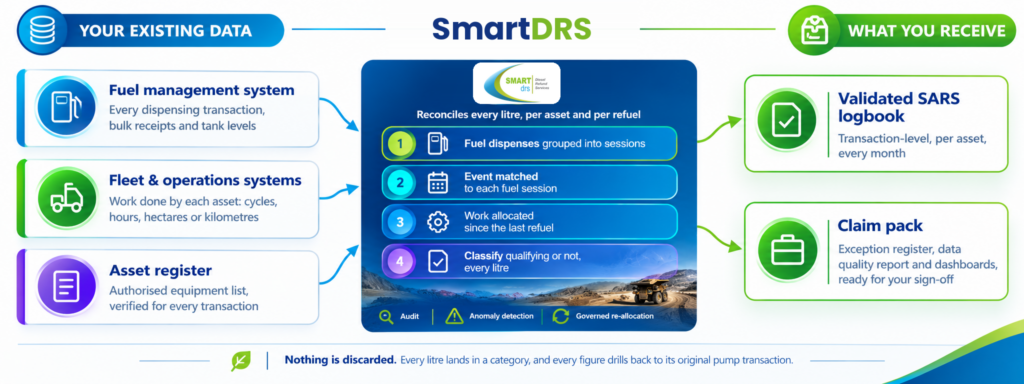
- Fuel-to-work reconciliation. Pump transactions are grouped into refuelling sessions and matched to the work recorded between refuels, whether that is production cycles, hours, hectares or kilometres.
- Every litre classified. Nothing is discarded. Every litre lands in a category, and the categories sum back to the total diesel issued.
- Anomaly detection and governed re-allocation. Implausible consumption and metering faults are flagged, and fuel booked to the wrong asset is corrected with a full audit trail, so the correction itself becomes evidence.
- A validated logbook every month. You receive a transaction-level logbook, approved by you and packaged for submission to SARS, with an exception register and a data quality report.
SmartDRS™ applies refund rates from a configurable rate table, so levy changes are handled without rework. It already works at the monthly, asset-level standard the modernised scheme is moving towards.
What to Do Now
- Register on the new system. Existing claimants are not moved across automatically.
- Check your asset register. Every claimed litre must be tied to an authorised, listed asset.
- Test your fuel-to-work link. Pick a month and see whether each fuel issue can be matched to the work that asset performed.
- Look for unclaimed equipment. Support and contractor equipment is often the largest untapped opportunity.
- Move from annual sampling to a monthly reconciled position. When SARS asks for evidence, it should already be there.
Prove Every Litre You Claim
The diesel refund is already owed. What has changed is how much it is worth, and how clearly you need to prove it. Find out how SmartDRS™ works, or contact ECS at info@enerserv.co.za to book a consultation and see where your claim is falling short.