
Where it all began
In October 1996, energy efficiency was rarely part of the boardroom conversation. In many industrial projects, it was not even a significant consideration during engineering design.
Founder Dr Mark Rawlins was working in process design and plant consulting, focusing on thermal equipment such as steam boilers, furnaces, dryers, reactors and combustion systems. The engineering was rigorous. But something was missing.
“I noted that there was little attention being paid to fuel and energy efficiency and emissions. These were seldom a consideration in projects and manufacturing operations,” he recalls.
Mark recognised an opportunity. If energy efficiency could be incorporated into the way industrial projects were designed and operated, organisations could achieve meaningful financial returns while improving productivity. But there was a fundamental problem: there was not enough data to prove it. And that realisation would become the foundation of ECS.
Energy efficiency is a commercial opportunity
From the beginning, ECS viewed energy efficiency differently. The case for energy efficiency was not primarily environmental. It was commercial.
Well-designed energy efficiency projects can deliver significant returns on investment while often improving productivity at the same time. In many cases, the technical solutions are already known. The challenge is identifying where opportunities exist, implementing the right interventions and, critically, proving the results.
For an industrial operation, reducing the amount of energy required to produce each unit of output can have a lasting impact on the cost base. It can improve productivity, reduce exposure to fuel and energy price volatility, and strengthen competitiveness. The challenge was convincing organisations to invest in something they could not easily see.
“It was hard. I was trying to convince our customers that energy efficiency really matters, and they could get a return on investment — all while there was not an industry-wide demand for these services,” says Mark.
That challenge became the purpose behind ECS: to combine engineering expertise, data, measurement and technology to identify opportunities and demonstrate their value.
The problem of measuring what you did not use
Energy efficiency has a unique measurement challenge. When a new production line is installed, the output can be counted. When a new piece of equipment is purchased, its performance can be tested. But an energy saving is different. You cannot physically see the energy that was never consumed.
As Mark explains: “The fact is that you cannot ‘see’ energy efficiency — there is no means of measuring energy you did not use. So energy savings cannot be measured.”
For businesses, this creates an important question: How do you prove that a saving actually happened? ECS made answering that question a core capability.
Over three decades, the company developed expertise in calculating savings and communicating results in a way that can be understood by operational teams, management, financial decision-makers and auditors.
“ECS has perfected the technical art of computation of savings and the communication of these results,” he adds.
This ability to measure and verify performance became one of the defining characteristics of ECS — and remains central to the business today.
From energy efficiency to a broader technology capability
ECS began with energy-efficient equipment supply for new and retrofit projects, supported by consulting services. Over time, opportunities in different industries and emerging technologies pushed the company to develop new capabilities.
Working with the fuel industry
One of the early breakthroughs came when Mark persuaded a major fuel supplier to offer energy efficiency and emissions management as part of its industrial fuel proposition. At the time, this was unusual.
The approach proved valuable for both the fuel supplier and its customers, and the solutions developed during this period established a foundation for the work ECS continues to do today.
Expanding into mining
The next major opportunity was mining. Applying energy efficiency principles within mining operations required a different level of technical and analytical capability. The scale of mining operations, the complexity of their processes and the depth of industry knowledge required created entirely new challenges. ECS responded by developing specialised solutions for the mining environment.
Measuring what had never been measured
As ECS worked more deeply within mining, another problem became apparent: important energy-impacting processes were often not being effectively measured or managed.
That insight drove the development of increasingly sophisticated electronic and digital systems, including ARID™ and SmartFEMS, and ultimately contributed to the establishment of TDX Lab, with specialist manufacturing, mechatronic and software engineering capabilities. The objective remained consistent: ff something affects performance, it needs to be measurable.
Measurement & Verification
ECS’s Measurement and Verification capability formalised another area of expertise that had been developing within the business for years. Accreditation as a Measurement and Verification Inspection Body opened opportunities to independently verify the performance of energy efficiency projects developed by other organisations.
This capability is particularly important where project performance, financial returns and contractual commitments depend on demonstrable energy savings.
Carbon, renewables and emerging technologies
As carbon emissions and renewable energy became increasingly important to industrial organisations, ECS expanded its capabilities again.
Specialist teams began working across areas including electrification, green fuels and emerging technologies, bringing together engineering, energy, data and technology expertise.
Today, ECS is focused on strengthening the connections between these capabilities to help customers address increasingly complex energy and productivity challenges.
What has carried ECS through 30 years?
Markets have changed dramatically since 1996. Technology has evolved. Customer expectations have changed. Energy and carbon have moved from niche engineering topics to strategic business priorities.
But when Mark reflects on what has carried ECS through three decades, he focuses less on markets and more on the habits that have shaped the organisation.
Taking on difficult problems
ECS approaches difficult problems with enthusiasm and a willingness to learn. Challenging problems are viewed as opportunities to develop capability, strengthen expertise and find better solutions.
Investing in research and development
ECS has consistently invested in R&D, even where the outcome is uncertain. This allows product development to stay ahead of contracted services and enables the organisation to identify emerging customer challenges before they become widespread problems.
Building and protecting knowledge
For more than two decades, ECS has maintained a dedicated focus on knowledge management. A deep and continually expanding knowledge base allows expertise to be shared across disciplines and retained within the organisation.
Investing in people
ECS has also invested heavily in multidisciplinary teams and in developing young talent. That includes taking calculated risks on graduates and early-career professionals with potential, giving them the opportunity to grow into highly skilled specialists.
At the same time, the business has retained a strong core of experienced team leaders, many of whom have been with ECS for more than a decade, with several having more than twenty years of experience.
The power of marginal gains
Perhaps the most fitting philosophy for an energy performance company is the practice of continuous improvement.
“We mindfully practice accumulation of marginal gains. We strive to be better every day. Half a per cent improvement per week accumulates to a 25% improvement for a year. Over 30 years, this has a huge beneficial impact on our service and product excellence,” says Mark.
The principle is simple: small improvements, consistently applied, compound into significant results. It is also exactly how industrial energy performance is improved.
ECS applies to its own business the same principle it asks its customers to apply to their operations. These practices are underpinned by three core values: Tenacity. Excellence. Connectedness.
A logo that captured the mission
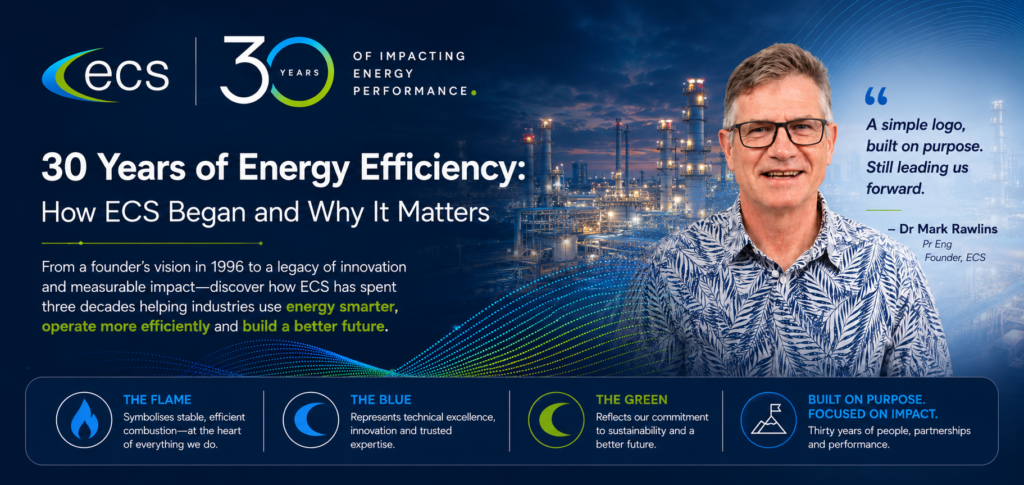
Even the ECS logo reflects the company’s original thinking. Mark designed the logo himself. There was no elaborate branding strategy behind it. It was simply intended to communicate something meaningful about what ECS believed in.
“I was not really focused on branding — little did I know that 30 years on, this remains relevant and it is still aligned with our core beliefs.”
Three decades later, that original idea remains relevant.
Why energy performance matters more than ever
The world has changed significantly since ECS was founded. Energy efficiency, carbon reduction and energy performance are now strategic priorities for organisations across industries. Customers, suppliers, investors and regulators are placing increasing emphasis on energy consumption, emissions and operational performance.
But this progress has created another challenge. There are now more technologies, products and service providers competing for the attention of industrial organisations than ever before. For customers, determining which solutions will actually deliver measurable results can be difficult.
As Mark puts it: “The speed of change has resulted in customers having difficulty differentiating between competent and incompetent service providers. Many offer products and services without an ability for performance verification.”
And this brings ECS back to the problem it identified in 1996. The challenge is not simply finding an energy-saving opportunity. The challenge is proving the result. That is why data, measurement and verification remain fundamental to the ECS approach.
A claimed saving needs to become a measurable saving. An assumption needs to become evidence. And an energy efficiency project needs to become a defensible business case.
Looking ahead: putting insight into customers’ hands
The next chapter for ECS is focused on making energy and operational intelligence increasingly accessible to customers. Significant investment is going into self-service functionality, recommendation systems, user-defined reporting and analytics.
The objective is simple: enable customers to extract value from their data at every level of their operation, without requiring deep engagement with an ECS professional for every question. Technology is also helping reduce the cost of operational support, creating further value for customers.
At the same time, ECS’s autonomous inspection systems are incorporating advanced edge computing and inferencing capabilities and are being deployed in increasingly demanding environments, including autonomous mining vehicles.
The opportunity ahead is to combine engineering expertise, data, measurement, software and emerging technologies in ways that help customers achieve their defined operational and energy performance goals.
30 years. One enduring belief.
ECS was founded in 1996 on an idea that industry was not yet ready to fully embrace: Energy efficiency is a competitive advantage — but only when you can measure and prove it. Thirty years later, the importance of energy performance is widely recognised.
The ability to demonstrate exactly what has been achieved remains a specialist capability. That is the thread connecting the ECS of 1996 with the ECS of 2026.
From process engineering and combustion systems to digital platforms, autonomous inspection, Measurement & Verification and advanced analytics, the technology has evolved. The purpose has not.
Measure better. Understand more. Improve continuously. Prove the result.
To the customers who have worked with ECS for fifteen and twenty years, to those who trusted us with unproven innovations, and to those who brought us their hardest problems and solved them alongside our teams — thank you.
And to the engineers, developers, technicians, analysts and specialists who have helped build ECS over the past 30 years: this milestone belongs to you too. Here’s to the next set of hard problems.
About Dr Mark Rawlins
Dr Mark Rawlins is the founder of ECS. He is a registered Professional Engineer, Certified Energy Manager and Certified Measurement and Verification Professional, an inductee of the AEE-SAEEC Hall of Fame, and a Wolfram Innovator of the Year.
- Want to make your energy performance measurable? Talk to ECS about how we can help.